
How TenXPR Made the
Fearless Fund a Household
Name

Body Language TV: Mastering Body Language for Tv Appearances
Body Language TV: Mastering Body Language for Tv Appearances
Mastering body language for a TV appearance comes down to getting posture, gestures, and eye contact working together, rather than leaning on any one signal to carry the moment. Research on hiring evaluators found that 84 percent weigh nonverbal cues heavily when judging a candidate's credibility. That finding comes from job interviews, not television, so applying it here is an inference rather than a tested result, but the basic instinct behind it, that people read a person's bearing alongside their words, plausibly carries over to a camera. Media training helps executives align these signals so they read as natural rather than rehearsed once the cameras roll.
Key Takeaways
- Posture, gestures, and eye contact register as one overall impression, not as isolated cues a single misstep can undo.
- Hiring research shows nonverbal signals weigh heavily in interview judgments; applying that logic to TV is a reasonable inference, not a proven finding about broadcast audiences specifically.
- Small, specific habits, hand placement, shoulder alignment, where the eyes land, do more for on-camera composure than general confidence-building advice.
- Composure on air comes from rehearsal and honest review after each appearance, not from accumulating bookings alone.
Why Does Body Language Make or Break TV Appearances?
Viewers form an impression fast, shaped largely by facial expression and posture, but that early read rarely hinges on a single gesture. A guest who shifts in their seat once or glances away briefly isn't written off for it; what matters more is the pattern across the segment, since fidgeting that recurs throughout an interview reads very differently than one brief moment of unease.
On-camera posture signals preparedness. Executives who rehearse it ahead of a booking tend to look steadier once the pressure of a live segment is real, mainly because the stance stops requiring conscious effort.
How Does Media Training Improve On-Camera Delivery?
Media training builds the repetition needed for steady, natural delivery on live television. Executives practice posture, pacing, and composure under realistic conditions, mock interviews, recorded run-throughs, unscripted Q&A, so those behaviors hold up once the lights and cameras are real rather than falling apart under pressure. It's one part of a longer preparation process, not a single session that fixes everything at once.
Why Pair Body Language Coaching With a Broader PR Strategy?
Posture and delivery alone won't secure a producer's trust or a repeat booking. Nonverbal coaching tends to work best alongside the other fundamentals of a media strategy: a clear narrative and a consistent presence across outlets over time. On-camera habits are one part of that larger picture, not a stand-alone fix.
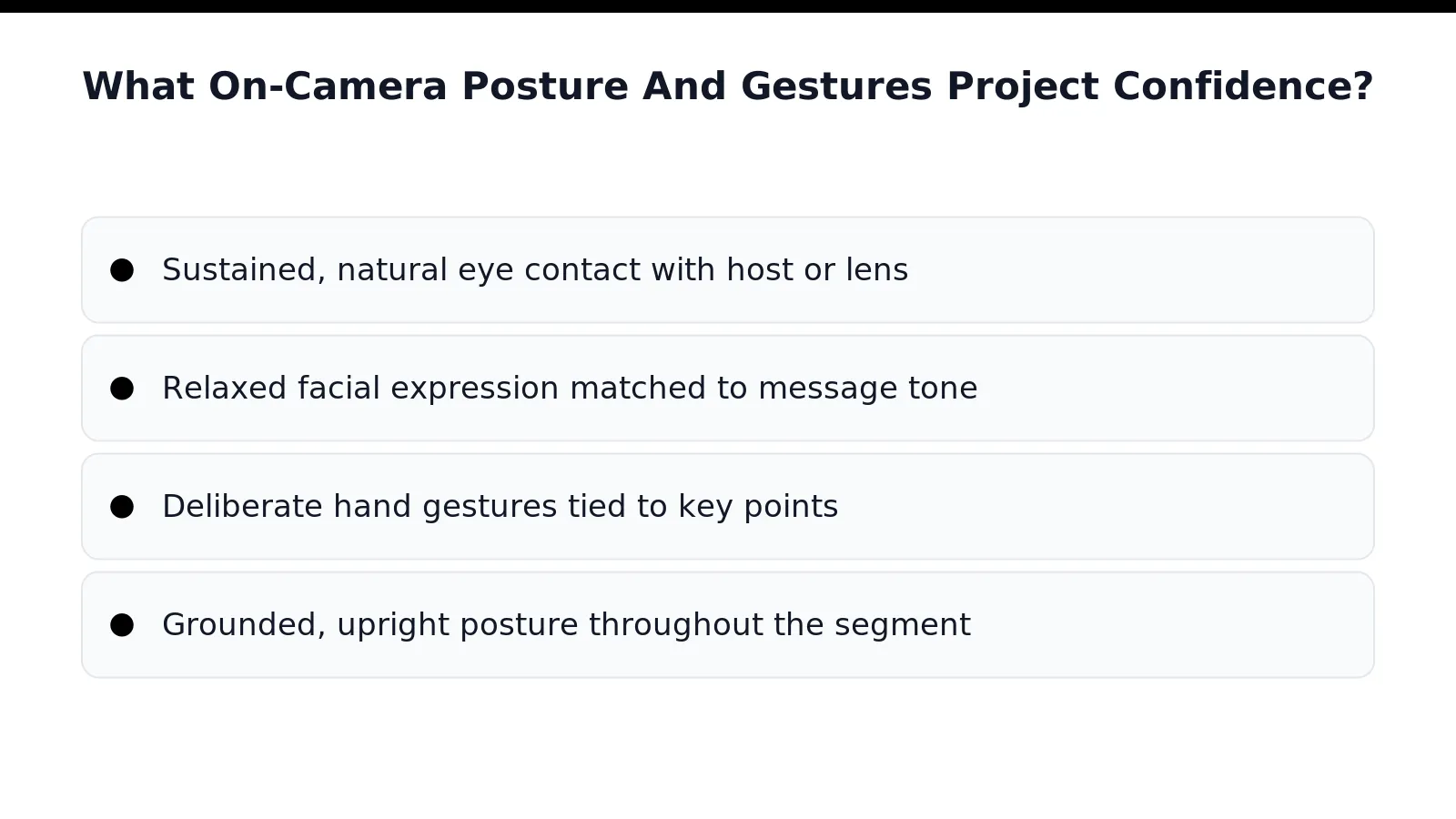
What On-Camera Posture And Gestures Project Confidence?
Four signals do most of the work on screen: steady eye contact, a relaxed facial expression, purposeful hand movement, and an upright on-camera posture. Executives who have these working together look at ease. When one slips, a wandering gaze or stiff shoulders, it tends to stand out more than the others.
Camera-specific advice, grounded in how a shot is framed, where a director cuts, and what a monitor actually shows, tends to be more useful than general public-speaking tips, because it reflects what producers notice in the moment rather than textbook presentation theory.
How should executives hold their hands during a TV interview?
Keep hands visible and at a natural height, roughly between the waist and chest, so the camera can see them without a producer needing to reframe the shot. Use a gesture to underline a specific point, then let the hands rest. Constant motion reads as nervous energy, and hands tucked under the table or clasped tightly read as guarded. A brief pause with still hands is rarely a problem; a gesture that doesn't connect to anything being said is what looks off. One habit worth rehearsing beforehand: resting hands loosely on the arms of a chair or lightly clasped in the lap between points, rather than deciding in the moment where they should go.
Does posture really change how an audience perceives a guest?
Posture shapes perception, more as a baseline impression than a single deciding factor. Slouching or leaning back reads as disengaged; sitting upright with shoulders square to the camera reads as present and in control. The effect builds over a longer segment: a brief slip is easy to overlook in a two-minute hit, but the same habit repeated across a longer interview starts to register.
What separates a guest who holds this together for ten minutes from one who starts strong and fades is usually fatigue, not nerves. A few adjustments help composure hold up as a segment goes on:
- Reset between questions: a breath and a shoulder drop after a tough question keeps posture from slipping later in the segment.
- Let the eyes move naturally between the host, a second guest, or a monitor cue, rather than locking into a stare.
- Save the strongest gesture for the point that matters most, not the first one that comes to mind.
- Expect at least one unscripted moment and have a plan for recovering posture and pace instead of freezing.

How Do Executives Build Lasting Camera-Ready Habits?
Camera-ready habits take hold through repeated practice and real appearances over time, not from a single coaching session ahead of one interview. A multi-month engagement, with several appearances built in, gives an executive room to find out what holds up on air and what doesn't. Repetition helps, but it isn't automatic: a guest can walk into a third or fourth booking just as tense as the first if nothing about the preparation changed in between. What tends to move the needle is reviewing each appearance afterward and adjusting specific habits, not the number of bookings by itself.
What's at stake in each booking also raises the bar. Earned media coverage, an appearance booked because a producer judged the story worth airing, rather than a paid or sponsored placement, comes with higher expectations. A producer or live host expects a guest who can hold up under unscripted questions, not one delivering a rehearsed pitch.
Why does body language matter so much in video and broadcast settings?
Broadcast adds a layer that in-person meetings don't have: the camera decides what the audience actually sees. A tight shot might catch a hand gesture that would look fine across a conference table but reads as exaggerated in close-up. Producers also cut to reaction shots and wide angles mid-answer, so posture and expression need to hold up even in moments a guest isn't the one currently speaking.
How does repeated TV exposure change executive communication?
Appearing on television repeatedly gives an executive more material to learn from: which moments felt natural, which habits crept in under pressure. It doesn't guarantee smoother delivery on any fixed schedule, and composure doesn't arrive automatically by the third or fourth hit. Reviewing footage after each appearance, and actually changing something based on what it shows, is usually what turns repetition into real improvement. Without that step, the appearances are just more of the same.
FAQ
What makes body language convincing on TV?
Consistency, not one flawless moment. A guest who stays relaxed through the questions that catch them off guard comes across as composed; an early stumble rarely changes that impression if the rest of the segment holds steady.
How quickly do viewers form an impression of a guest?
Quickly, but not permanently. Early impressions lean heavily on posture and expression, and a guest who settles in after a rough start usually recovers that impression by the end of the segment.
What should executives do with their hands on camera?
Keep them visible, at a natural height, and save movement for the points worth underlining. Hands pinned under a table or clasped tightly tend to read as tense, even when the rest of the delivery is calm.
Conclusion
The habits that read as composed on air are specific and ordinary: hands at a natural height, shoulders square to the camera, eye contact that holds without turning into a stare, gestures that land on an actual point. None of this requires a new personality on screen. It requires rehearsing those habits enough times that they hold up through an unscripted question and a live clock.

At TENXPR, our mission is to
execute all of our available
resources, knowledge, expertise,
and team collaboration to create
a powerful story and visibility for
your brand.
Links


